
Most people searching for an electrician are not enjoying the process. Something has stopped working, or a survey has flagged something, or a job needs doing before a room can be finished. You want someone competent, local, and available, and you want to stop thinking about it.
The trouble is that from the outside, every electrician's website says roughly the same thing. So here is a practical guide to what actually separates one from another, written by people who do the work in Weybridge and the surrounding area every week.
Check registration, and check what it covers
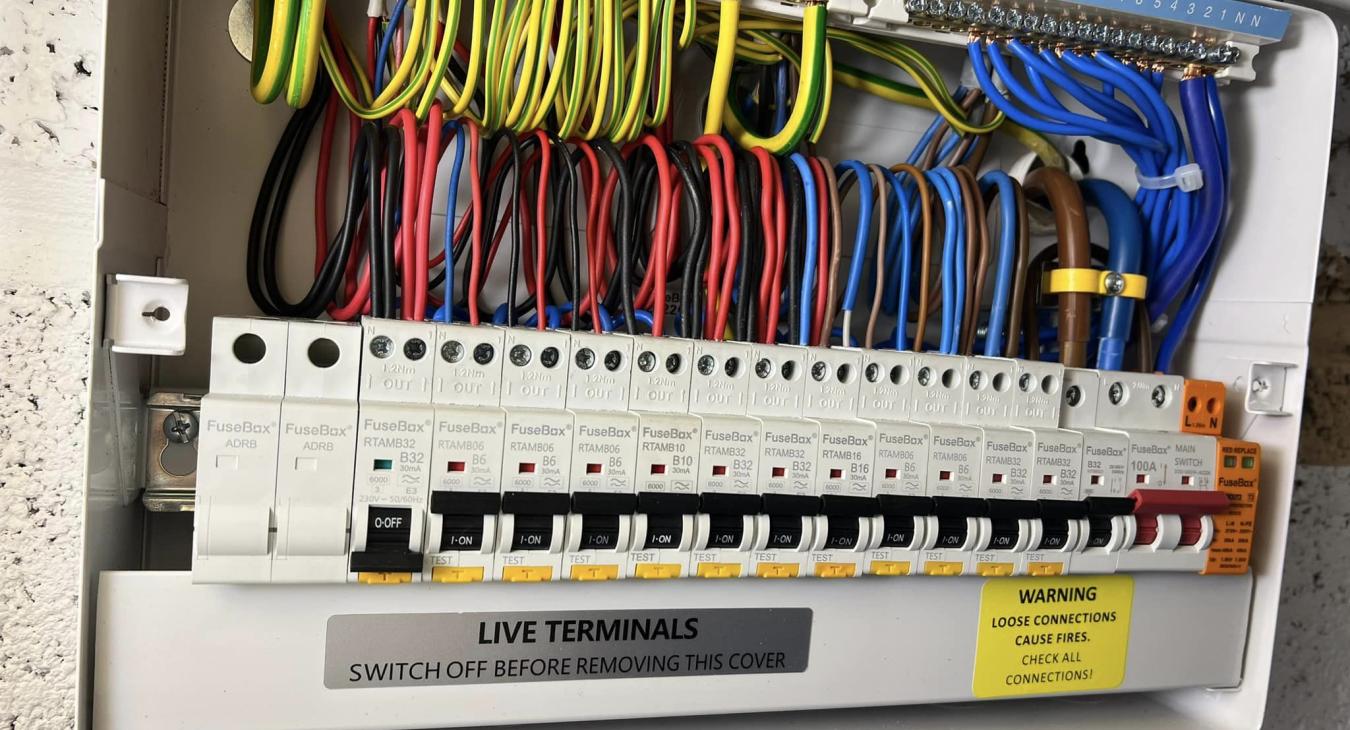
In England, certain electrical work in a home is notifiable under Part P of the Building Regulations. The scope was trimmed in 2013, and what remains notifiable is three things: installing a new circuit, replacing the consumer unit, and additions or alterations to an existing circuit in a special location such as a bathroom or a room containing a swimming pool or sauna heater.
In plain terms: a new fusebox, a brand new circuit, or electrical work in your bathroom needs signing off. Adding a socket to an existing circuit in your lounge does not, though it still has to be done to the same safety standard.
What this means for you is simple. If you are having any of that first group done, the work must either be signed off by building control or certified by an electrician registered with a competent person scheme. If it is not, it will surface when you sell the house and cost you more to put right then.
This is the first thing to check, and it is easy to check. Registration can be verified directly on the scheme's own website. We are an NICEIC Approved Contractor, which is NICEIC's assessed commercial and domestic tier rather than the domestic only registration, and it can be checked on the NICEIC register in under a minute. You do not have to take anyone's word for it, and you should not have to.
One nuance worth knowing. Registration is not a single blanket qualification. Schemes register businesses for particular types of work, and a firm registered for domestic installation work is not automatically approved for everything. If you are having something less common done, it is reasonable to ask whether their registration covers it.
Understand what "qualified" actually means
There is no single qualification that makes someone an electrician, which is part of why this is confusing.
What you want is someone who holds a recognised electrical installation qualification, who is up to date with the current wiring regulations, and who holds a separate inspection and testing qualification if they are going to be writing you a condition report. That last one matters more than people realise, because inspecting an installation and installing one are different skills with different qualifications behind them.
A competent electrician will not be even slightly offended by being asked. It is a fair question and the answer should come straight back.
Insurance is not optional and neither is a written quote
Public liability insurance should be in place and current. Ask for the certificate if you want to see it.
On quotes, the thing to look for is not the lowest number. It is the clearest one. A proper quotation tells you what work is included, what materials are being used, what is excluded, and what happens if something unexpected turns up once the work starts. On older properties, something unexpected turning up is fairly normal, so knowing in advance how that will be handled is worth more than a slightly better price.
Be careful with a number given over the phone before anyone has seen the job. It is not dishonest, but it is a guess, and guesses move.
Expect a certificate, not just an invoice
This is the single most common gap we come across.
Work gets done. It gets paid for. No certificate is ever issued. Then the property gets sold, or remortgaged, or a survey flags it, and there is nothing to demonstrate the work was done properly.
For most jobs you should receive one of the following. An Electrical Installation Certificate for new installation work. A Minor Electrical Installation Works Certificate for smaller alterations. An Electrical Installation Condition Report if you have had an inspection. And for notifiable work, a Building Regulations compliance certificate, which usually arrives separately from the scheme provider some weeks later.
Keep all of it. It costs nothing to file and it is genuinely valuable when you come to sell.
What "near me" actually gets you
Distance matters more than people assume, for two reasons.
The obvious one is response time. If something has failed and you need someone today, a firm working in Weybridge and the immediate area can usually get to you in a way that someone travelling across the county cannot.
The less obvious one is familiarity with local housing. Weybridge is not one type of property. There are large detached houses on the private estates, period properties around the village and Oatlands, riverside homes near the Wey, and newer apartment developments over towards Brooklands. Each of those brings different electrical situations.
Large properties frequently have three phase supplies, multiple distribution boards, outbuildings, gates, pools and extensive external lighting. That is a different job to a two bedroom flat, and it needs someone who has worked on that scale before.
Period properties bring the usual older wiring questions, along with the practical difficulty of running anything through solid walls without wrecking finishes that someone has spent money on.
Properties near the river bring flood considerations. Where a property has a genuine flood risk, decisions about the height of socket outlets, the position of the consumer unit, and how circuits are split all become worth thinking about properly rather than defaulting to standard practice.
Access is another one. Some of the private estates around Weybridge have their own arrangements for contractors coming in and out. Someone who works here regularly already knows how that works.
Reasonable red flags
None of these means someone is a cowboy on its own, but together they are worth paying attention to.
No written quotation, only a verbal number. No mention of certification at any point. Reluctance to give a registration number. Cash only, with a discount for paying that way. Pressure to decide immediately. A price that is dramatically below everyone else, which usually means either something has been left out of the quote or something is going to be left out of the job.
What a straightforward job should look like
For most domestic work, the sequence is fairly predictable. Someone comes and looks at the job. You receive a written quotation. Work is scheduled and you are told roughly how long it will take and what disruption to expect. The work is carried out, tested, and certified. You get the paperwork.
If that is not how it is going, that is usually a sign.
Getting someone out
We are based in Walton-on-Thames, a few minutes from Weybridge, and cover Weybridge and the surrounding Elmbridge area for domestic electrical work. That runs from fault finding and additional sockets through to consumer unit upgrades, full rewires, smoke and heat alarms and inspection reports. You can see the full list of areas we cover here.
If you have something that needs looking at, get in touch and we will arrange a time to come and see it properly. Whatever you decide to do from there, you will at least know what you are dealing with.